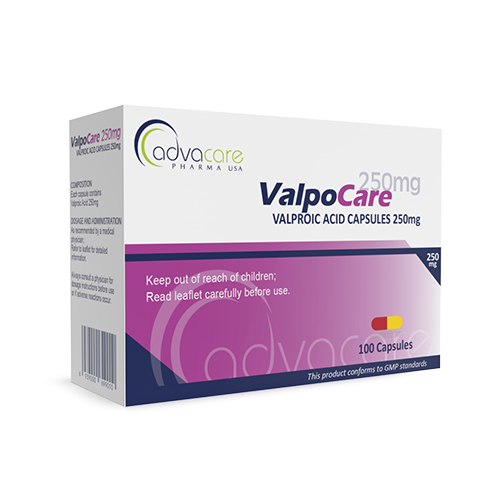
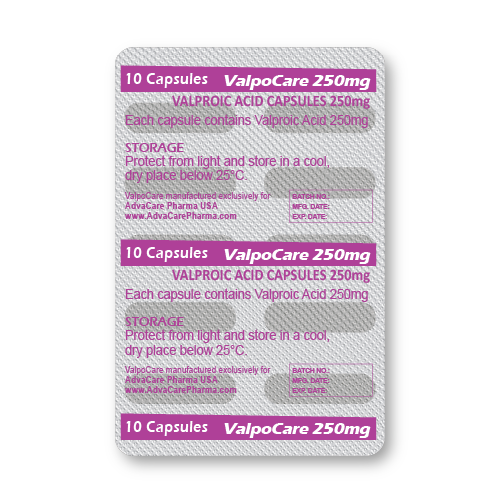

Valproic Acid Capsules
Dosage
Packaging
What is Valproic Acid?
Active Ingredients: Valproic Acid
Valproic Acid Capsules are a drug that is used to treat certain types of seizure disorders, such as complex partial seizures. This medication is also indicated for the treatment of manic episodes associated with bipolar disorder. Valproic Acid is sometimes prescribed as prophylaxis for migraine headaches.
Valproic Acid is classified as an anticonvulsant. Though its exact mechanism of action is not defined, it is known to work as a GABA modulator and as a voltage-gated sodium channel blocker. It also inhibits the action of histone deacetylases.
AdvaCare Pharma's Valproic Acid Capsules are manufactured in GMP-certified factories located in China, India, and the USA. We routinely inspect our production facilities to ensure our products meet health, safety, and environmental standards.
Why are we a quality Valproic Acid manufacturer?
AdvaCare Pharma is a GMP manufacturer of Valproic Acid Capsules. Our strategically located facilities ensure that our company has complete control over the supply chain, meaning higher quality products and lower costs for transportation and importation. Over the past 20 years, we have built a solid reputation as a leading manufacturer of pharmaceutical products across 65 countries.
Uses
What is Valproic Acid used for?
It is used to treat seizure disorders, including complex partial seizures, and simple and complex absence seizures. Valproic Acid is also indicated for the treatment of acute manic bipolar disorder and as migraine headache prophylaxis.
How are Valproic Acid Capsules used?
This medication is manufactured to be taken orally.
What dose should be taken?
For seizures, the usual dose is 30-60mg/kg, divided and taken 2 or 3 times per day.
For acute manic bipolar disorder, the usual dose is 240-500mg, taken 3 times per day.
For migraine headache prevention, the usual dose is 250-500mg, taken twice per day.
Refer to a doctor or pharmacist for more specific guidelines on dosage. Do not exceed what they advise.
Side Effects
As with all pharmaceuticals, some unwanted effects can occur from the use of Valproic Acid Capsules.
Common side effects include, but may not be limited to:
- gastrointestinal disturbances
- headache
- dizziness, tiredness, drowsiness
- tremors
- changes in vision
- hair loss
- weight changes
Seek medical attention if the following develop:
- signs of an allergic reaction
- mental changes, including confusion
- unexplained bruises or bleeding; purple pinpoint spots under the skin
- severe drowsiness
- worsening seizures
Consult a doctor or pharmacist for a comprehensive list of all side effects.
If any symptoms persist or worsen, or you notice any other symptoms, please call your doctor immediately.
Precautions
Do NOT use Valproic Acid Capsules if:
- You are allergic or hypersensitive to any of the ingredients.
- You have liver disease.
- You have a urea cycle disorder.
- You have Alpers' disease or another genetic mitochondrial disorder
This medication may not be suitable for people with certain conditions, including:
- liver problems associated with a genetic mitochondrial disorder
- mood disorders or suicidal thoughts
- family history of urea cycle disorder
- HIV or CMV infection
Suicidal thoughts may occur in young patients. It is important to have regular progress updates with a physician and for caregivers and families to pay attention to changes in mood.
This medicine should only be used during pregnancy and breastfeeding if the benefits outweigh the risks. Consult a doctor or healthcare professional before treatment.
Female Contraception: Female patients must use effective birth control while being treated with this medication. Note that estrogen-containing contraceptives may interact with valproic acid and reduce its efficacy in preventing seizures.
Male Contraception & Paternal Risk: Following regulatory safety updates from the EMA PRAC and UK MHRA regarding paternal valproate exposure and potential neurodevelopmental risks in offspring, male patients taking valproic acid must use effective contraception during treatment and for at least 3 months after stopping. Male patients must also refrain from donating sperm during treatment and for 3 months post-discontinuation.
Many drugs are known to interact with Valproic Acid, including amifampridine, bupropion, dalfampridine, and metoclopramide.
Avoid drinking alcohol while undergoing treatment with this medicine. Do not drive or operate heavy machinery until the effects of the medicine are clear.
References
European Medicines Agency (EMA) PRAC Safety Recommendations on Paternal Valproate Exposure
This safety evaluation analyzed retrospective observational database studies from Nordic countries assessing potential neurodevelopmental risks in children born to fathers treated with valproate during the 3 months preceding conception.
Data indicated a small, potential increased risk of neurodevelopmental disorders in offspring fathered by men treated with valproate compared to alternative anticonvulsants such as lamotrigine or levetiracetam.
The European Medicines Agency concluded that precautionary measures—including mandatory effective contraception for male patients during treatment and for 3 months post-discontinuation, along with sperm donation restrictions—must be incorporated into international product information.
UK Medicines and Healthcare products Regulatory Agency (MHRA) Safety Update: Male Patient Management
This national regulatory update evaluated clinical evidence regarding paternal valproate exposure, spermatogenesis cycles, and potential transgenerational neurodevelopmental outcomes in offspring.
The study highlighted a cumulative neurodevelopmental disorder risk of 4.0% to 5.6% in children born to fathers exposed to valproate, compared to 2.3% to 3.2% in control monotherapy groups.
The UK MHRA established practice guidelines recommending that male patients and their partners utilize effective contraception throughout treatment and for at least 90 days after discontinuation to cover a complete sperm development cycle.
The BMJ Safety Alert: Valproate Paternal Exposure and Contraception Protocols
This peer-reviewed analysis reviews regulatory warnings issued for male patients prescribed valproic acid or sodium valproate for epilepsy and bipolar disorder.
The review emphasizes that male patients planning a family within 12 months should undergo clinical review to evaluate alternative therapeutic options prior to conception.
It concludes that while paternal exposure risks are significantly lower than maternal in utero exposure risks, strict adherence to barrier and partner contraception protocols remains essential for male patients on active valproate regimens.
