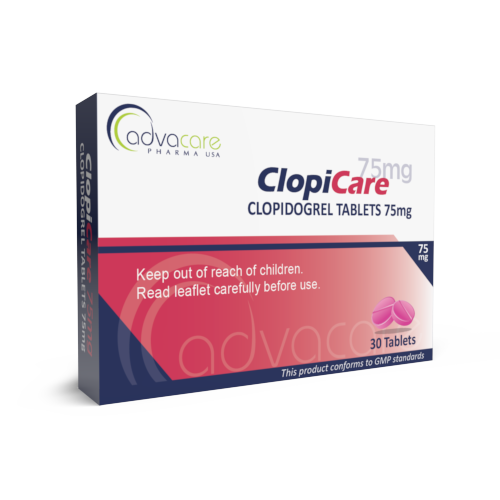


Clopidogrel Tablets
Dosage
Packaging
What is Clopidogrel?
Active Ingredients: Clopidogrel
Clopidogrel is an oral P2Y12 antiplatelet medicine used to reduce atherothrombotic events in appropriate patients. Depending on the approved labeling in each market, uses may include recent myocardial infarction, recent ischemic stroke, established peripheral arterial disease and acute coronary syndromes. In some acute coronary syndrome settings, clopidogrel is used in combination with aspirin.
Clopidogrel is a prodrug. Its active metabolite inhibits platelet activation and aggregation by irreversibly binding to the platelet P2Y12 ADP receptor.
Clopidogrel prevents the formation of blood clots by stopping platelets (blood cells that cause blood clotting) from sticking together.
AdvaCare is a GMP-certified producer and supplier of Clopidogrel Tablets. This medication is manufactured in our factories in China, India, and the USA. We routinely inspect our manufacturing facilities to ensure our products meet quality and safety standards.
Why are we a leading Clopidogrel manufacturer?
Clopidogrel Tablets are manufactured and distributed by AdvaCare Pharma, an American-owned and operated company.
We are committed to creating sustainable and cost-effective pharmaceutical products to improve access to healthcare solutions worldwide. As a Clopidogrel manufacturer, we are proud to work with international partners including pharmaceutical distributors, pharmacies, hospitals and many other medical and government institutions.
Uses
What is Clopidogrel used for?
It is used to reduce the risk of heart attacks and strokes in people with heart disease, recent stroke, or blood circulation disease.
How should Clopidogrel Tablets be used?
This medication is intended to be taken orally.
What dose should be taken?
Clopidogrel 75mg once daily is a common adult maintenance dose. Some acute coronary syndrome or PCI regimens use a loading dose before continuing 75mg once daily. The appropriate dose and duration depend on the indication, concomitant antithrombotic therapy and the locally approved prescribing information.
What did the A-CLOSE trial find about long-term clopidogrel after high-risk PCI?
In the 2026 A-CLOSE randomized Phase IV trial, 3,203 patients at high ischemic risk who had completed 12 months of DAPT after drug-eluting stent implantation were assigned to clopidogrel monotherapy or extended DAPT for 24 months. Net adverse clinical events occurred in 5.0% versus 5.1%, respectively. The ischemic composite occurred more often with clopidogrel monotherapy (3.7% vs 1.6%), while BARC type 2, 3 or 5 bleeding occurred less often (1.8% vs 4.1%). The findings demonstrate an ischemia–bleeding trade-off; long-term antiplatelet therapy should therefore be individualized according to ischemic and bleeding risk.
Side Effects
As with all pharmaceuticals, some unwanted effects can occur from the use of Clopidogrel Tablets.
Common side effects include, but may not be limited to:
- bleeding
- itching skin
- fever
For a comprehensive understanding of all potential side effects, consult a medical professional.
If any symptoms persist or worsen, or you notice any other symptoms, please call your doctor immediately.
Precautions
Do NOT use Clopidogrel Tablets if:
- You are allergic to any of the ingredients.
- You have a severe bleeding problem.
- You are going to have a surgical procedure.
- You have serious liver damage.
- You have any blood-related disorders.
Before treatment, consult your doctor regarding any medications you are taking to address potential drug interactions.
This medication may not be suitable for people with certain conditions, so it is important to consult with a doctor if you have any health conditions.
Clopidogrel 75mg: Why the most common dose?
Clopidogrel 75mg is a widely used maintenance dose in adults and is the dose used in many approved indications. In acute coronary syndrome or PCI, treatment may begin with a loading dose before continuing 75mg once daily. The appropriate regimen and duration depend on the indication, concomitant antithrombotic therapy, ischemic risk, bleeding risk and local prescribing information.
References
Clopidogrel or Dual Antiplatelet Therapy in High-Ischemic-Risk Patients
This study evaluated clopidogrel monotherapy compared with extended dual antiplatelet therapy (DAPT) in 3,203 patients at high risk of ischemic events who had completed 12 months of DAPT after drug-eluting stent implantation.
Patients were randomized to receive clopidogrel monotherapy or clopidogrel plus aspirin for an additional 24 months. Net adverse clinical events occurred in 5.0% of patients receiving clopidogrel monotherapy and 5.1% of those receiving extended DAPT, meeting the study's criterion for noninferiority. However, the key ischemic endpoint occurred more frequently with clopidogrel monotherapy (3.7% vs. 1.6%), while BARC type 2, 3 or 5 bleeding occurred less frequently (1.8% vs. 4.1%).
The findings demonstrate an important trade-off between ischemic protection and bleeding risk. Clopidogrel monotherapy reduced clinically important bleeding, while extended DAPT provided greater protection against major ischemic events in this high-risk population.
New Insights on the Optimal Duration of Antiplatelet Therapy After Stent Implantation
The European Society of Cardiology reported the A-CLOSE trial results presented at ESC Congress 2026, which compared clopidogrel monotherapy with extended DAPT in patients at high ischemic risk following drug-eluting stent implantation.
The results showed that clopidogrel monotherapy was associated with fewer clinically important bleeding events, whereas extended DAPT provided greater protection against ischemic cardiovascular events. The overall net clinical outcome was similar between the two treatment strategies.
The findings support an individualized approach to long-term antiplatelet therapy after PCI, taking into account each patient's ischemic and bleeding risks rather than applying one treatment strategy universally.
